

 中文
中文Data Services



Supports more than 20 DataBase, NoSQL, MPP mainstream data sources, covering the generation, release, authorization, and invocation of full lifecycle management from APIs.

Support AK authentication, table-level permissions, data encryption, isolated storage, security auditing and other security mechanisms.

Provide data services externally through API gateways, millisecond query response time, and QPS support more than 10,000 levels.

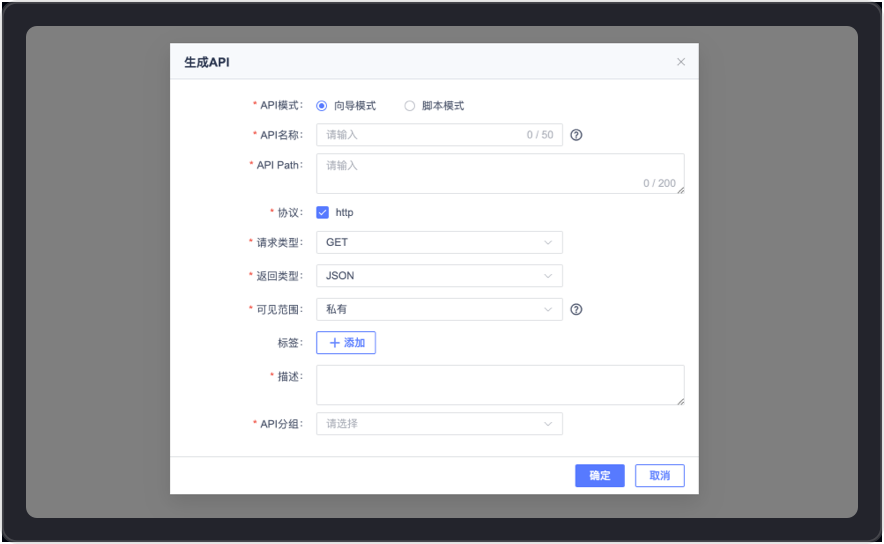
Shield the details of the underlying data source, build the fetch API through the wizard mode/script mode, and support a variety of operators, connectors, subqueries, and other capabilities to greatly simplify the complexity of API creation. Configuration is development, and it can be quickly generated in 3 minutes. At the same time, the stock API can be registered to the platform for unified management.
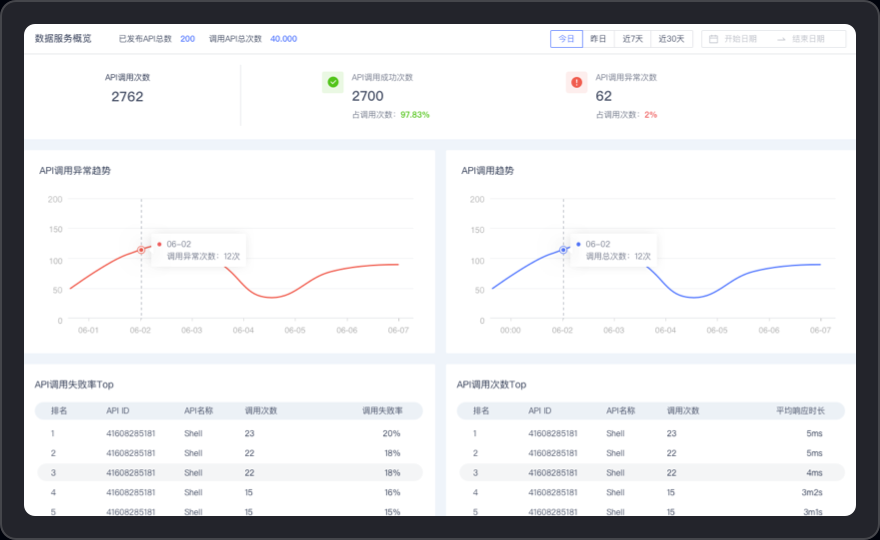
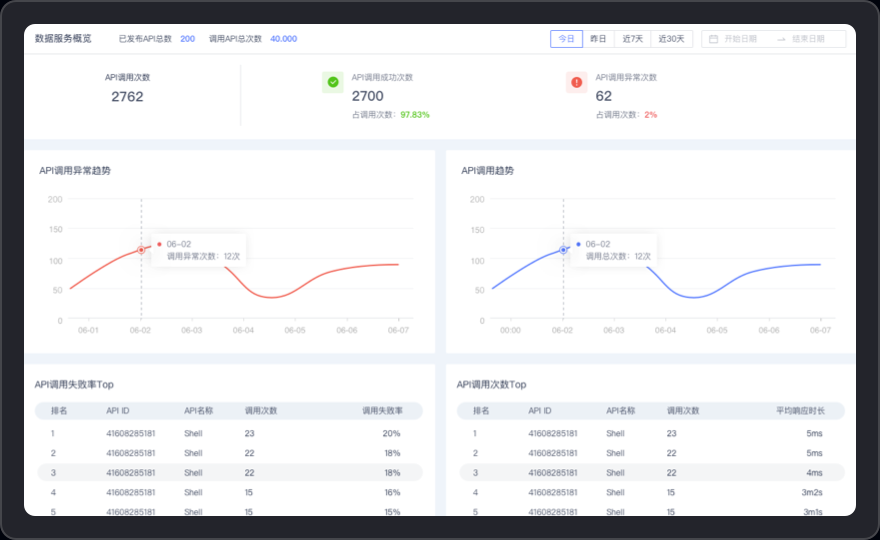
It enables developers and managers to easily view the monitoring statistics and analytical calls of the service, and supports the full life cycle management of the service from on-line, authorization, call, off-line, etc. Provide calls to configure service interfaces and access rights, access policies, etc. Support service abnormality early warning mechanism.

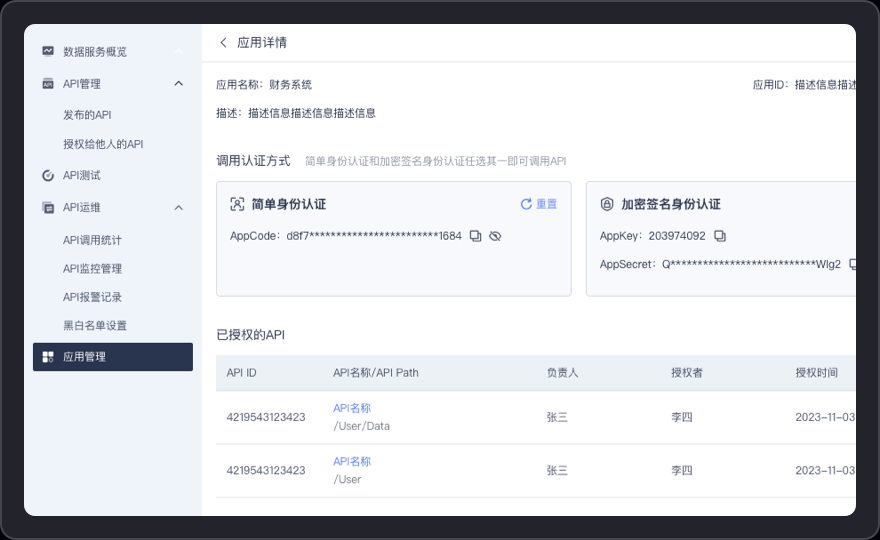
Provides application registration, editing, and deletion management, supports APPKey and APPsecert key group authentication methods, and also supports apiToken authentication methods. In addition, through the resource group configuration function, independent query resources are set for the core API, so that non-core APIs can share query resources and improve resource utilization.

Provide the user rights management mechanism and the authentication policy of the application interface. Support security measures such as encryption and desensitization of API calls. Provide encryption desensitization, authentication, black and white list and other functions.
Shield the details of the underlying data source, build the fetch API through the wizard mode/script mode, and support a variety of operators, connectors, subqueries, and other capabilities to greatly simplify the complexity of API creation. Configuration is development, and it can be quickly generated in 3 minutes. At the same time, the stock API can be registered to the platform for unified management.


Business Pain Points
Chaotic service management: Lack of a unified platform for API authentication, flow limitation and call management, resulting in huge database pressure.
Rough service quality: APIs come from a variety of sources and specifications, and data integrity, security and consistency are difficult to guarantee, affecting business high availability.
Complex service modes: The data service modes are diverse, and the business departments need to invest a lot of development costs to adapt, and the application efficiency is inefficient.
Business Value
Through the construction of a unified API service platform, the standardized management and consistent services of the API are realized. The platform unifies the service mode and interface structure, making business integration more convenient and greatly improving the efficiency of data application. At the same time, the manager can control the downstream call authority, frequency and number of API calls to ensure the security and stability of data calls.
Business Pain Points
Chaotic service management: Lack of a unified platform for API authentication, flow limitation and call management, resulting in huge database pressure.
Rough service quality: APIs come from a variety of sources and specifications, and data integrity, security and consistency are difficult to guarantee, affecting business high availability.
Complex service modes: The data service modes are diverse, and the business departments need to invest a lot of development costs to adapt, and the application efficiency is inefficient.
Business Value
Through the construction of a unified API service platform, the standardized management and consistent services of the API are realized. The platform unifies the service mode and interface structure, making business integration more convenient and greatly improving the efficiency of data application. At the same time, the manager can control the downstream call authority, frequency and number of API calls to ensure the security and stability of data calls.



WeChat Official Account

WeChat Tech Account

Douyin Account

WeChat Group Chat
WeChat Official Account
WeChat Tech Account
Douyin Account
WeChat Group Chat